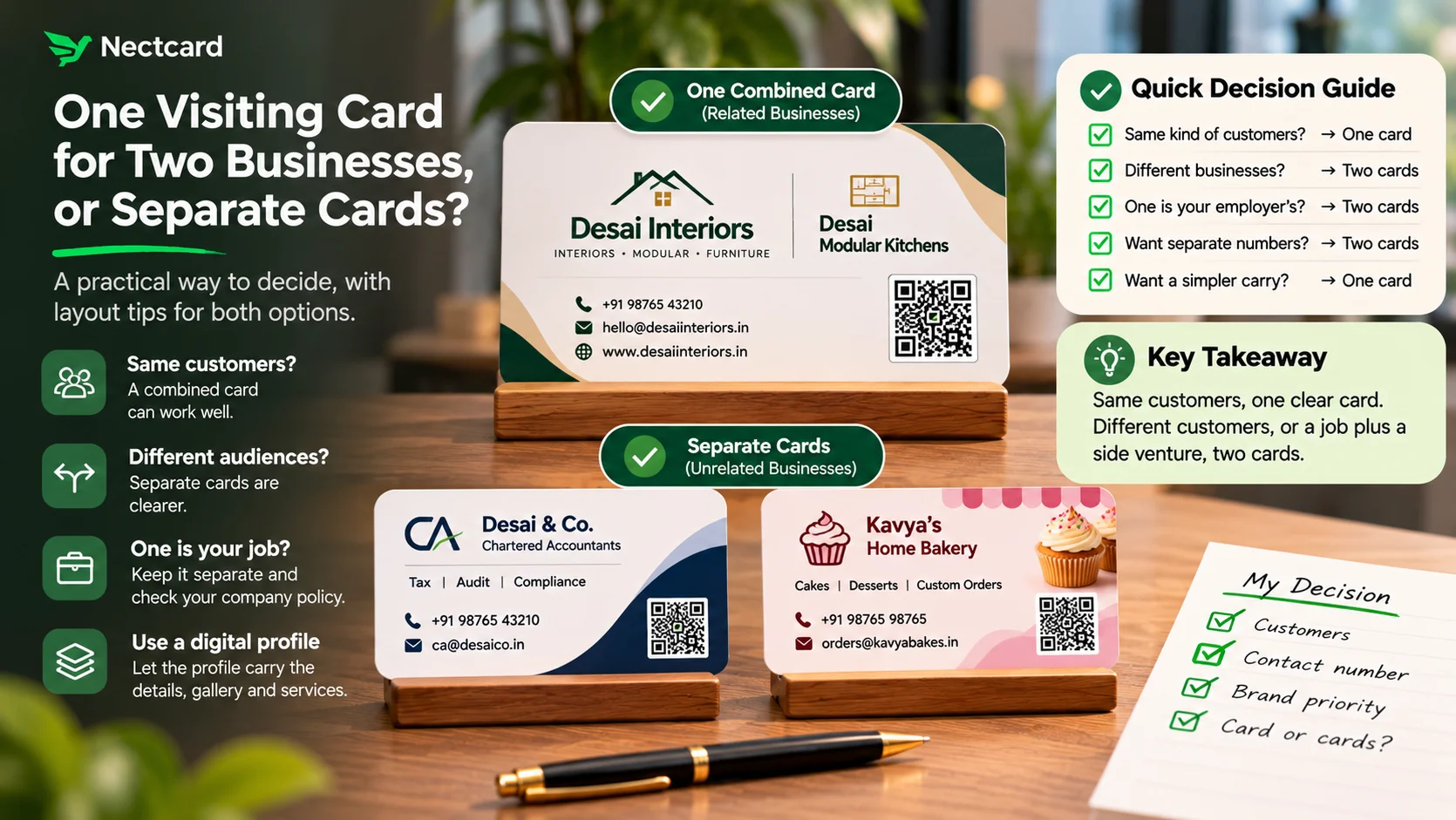
If your two businesses serve the same kind of customer, one card with one clear lead brand usually works. If they serve different people, or one is your job and the other is a side venture, separate cards are cleaner. The test is simple: would the person you're handing the card to care about both?
Plenty of people in India juggle two things. A CA who also runs a training academy. A family textile business plus your own design studio. A salaried job and a weekend photography gig. At an expo or a wedding, you've got about two seconds to hand over a card, and it shouldn't leave the other person confused about what you do.
When one combined card makes sense
- The businesses are related, like interiors and modular furniture, or a clinic and a pharmacy.
- The same person would buy from both.
- You share one phone number and email for both.
- You want to carry fewer cards and keep printing costs down.
Print guides from Vistaprint and 4over4 both point out the catch: space. 4over4 puts the practical limit at two logos on a standard card, and makes the point that two equal-sized logos read as neither, so one brand should lead.
When separate cards are better
- The businesses have nothing in common, like a CA practice and a cake business.
- One of them is your employer's. Your company card belongs to your job, so keep side work off it, and check your employment terms before promoting a side venture at work events.
- You want to know which business a call is for. One investor on a BiggerPockets forum thread said he uses two cards with two numbers for exactly this reason.
- Each business needs its own tone. A law firm card and a music class card shouldn't look the same.
Advice varies here. In that same forum thread, another member argued for one simple card unless the businesses are truly separate, because people remember the conversation more than the card. Both agreed on one thing: keep it simple.
Quick comparison
| One combined card | Separate cards | |
|---|---|---|
| Best for | Related businesses, same customers | Unrelated businesses, or job plus side venture |
| Printing | One design, one print run | Two designs, two print runs |
| Clarity | Can get cluttered with two logos | Each card has one clear message |
| Tracking calls | Harder to tell which business a call is for | Easier if each card has its own number |
| What you carry | One stack | Two stacks, and the risk of handing over the wrong one |
If you go with one card, here's how to lay it out
- Pick a lead brand. It goes big on the front.
- Put the second business on the back, or as a smaller logo near the bottom.
- Use one shared contact block: one phone, one email, one website if you can.
- Keep long descriptions off the card. Put them on your website or profile instead.
- Add a QR code that opens a page listing both businesses, so the card doesn't have to hold everything.
- Print a small test batch before a full run, and proofread both sides.
What about digital cards?
Digital cards make this easier, but check how your provider handles it. Some apps let one account hold several cards or profiles. HeyDrop's help page, for example, describes separate cards for work, freelance and personal use on its paid plan, and V1CE's help page describes pointing different physical cards to different profiles. Free plans on both are described as allowing one card. Ask before you buy if you need two.
A Nectcard profile can list your services and products, a gallery, links to your website and socials, and a downloadable PDF brochure, so one profile can cover two related lines of work. If the two businesses are unrelated, it's usually cleaner to keep them on separate cards.
Who this helps most
- Freelancers and consultants: if you offer two services to the same clients, like branding and web design, one profile with both listed under services usually beats two cards.
- Creators and coaches: keep your coaching card about coaching. Brand deals and content work can live on a separate card or a link on your profile.
- Real estate: if you also run a home-loan or interiors tie-up, lead with property and mention the tie-up on the back or your profile, so buyers aren't confused about your main role.
- Restaurants and retail: owners with two outlets under different names often do better with separate cards, so each customer gets the right address and menu.
Planning your card?
Use the checklist to decide what goes on the card and what goes on the profile.
So, one or two?
Same customers, one card with a clear lead. Different customers, two cards. And if one of them is your employer's business, keep it separate. Whatever you pick, a simple card that clearly says what you do will be remembered long after a crowded one.