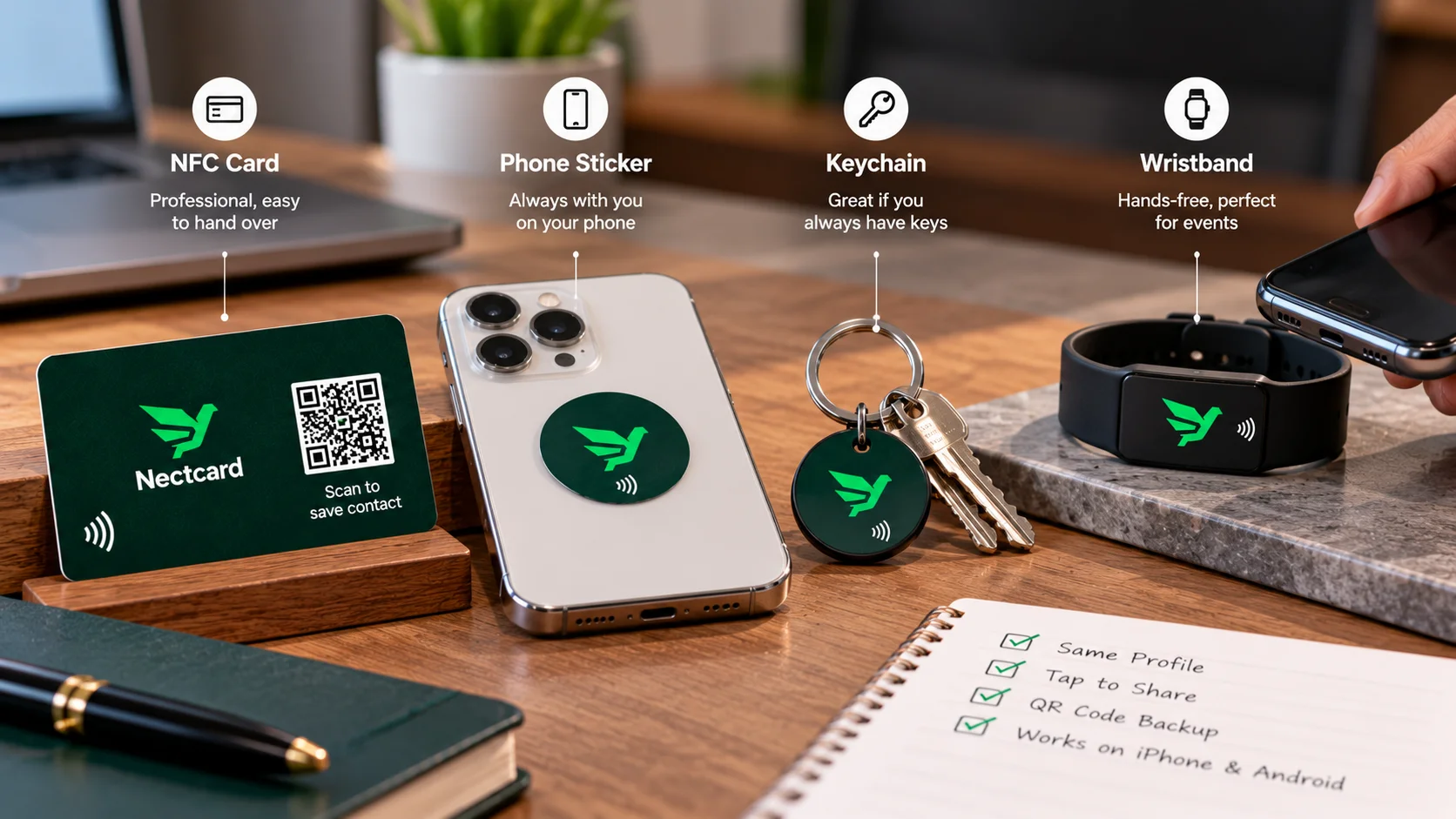
For most people, a card is still the safest pick. It fits in a wallet, has room for your name and a printed QR backup, and you can hand it over or leave it behind. A phone sticker suits people whose phone is always in hand, a keychain suits people who forget their wallet, and a wristband is mostly useful at events.
Same chip, different clothes
Underneath, these products do the same job. A small NFC chip holds a link, and when someone touches it with their phone, your profile opens. Brands that sell digital business cards often offer the same thing as a card, keychain, phone sticker or wristband, and the accessories link to your profile the same way a card does. The person tapping doesn't need an app.
So you're not choosing between technologies. You're choosing where the chip lives and how people will reach it.
Side by side
| Card | Phone sticker | Keychain | Wristband | |
|---|---|---|---|---|
| Where it lives | Wallet or cardholder | Back of your phone or inside its case | On your keys | On your wrist |
| Can you hand it over? | Yes | No, it stays on your phone | Not really | No |
| Room for your name and a QR code | Yes | Small | Very little | Very little |
| Main catch | One more thing to carry | Adhesive is usually one-time; metal backs block it | The other person taps your keys | Mostly suits events |
| Best for | Client meetings and first introductions | People who always have their phone out | Field work, people who forget wallets | Expos, conferences and workshops |
Where the other phone has to touch
This part is the same for every format. On iPhones, the NFC reader sits at the top edge, so the top of the phone needs to touch the chip. On most Android phones, the reader is on the back, near the top or centre. The other person's phone needs NFC switched on, and on iPhones, reading a tag without opening an app needs an iPhone XS or later. More on this in do NFC cards work on iPhone and Android.
Metal gets in the way. Keys or coins near the chip can disrupt the signal, and metal or metal-backed phone cases can block it completely. Keep that in mind with keychains and stickers in particular.
Phone stickers: handy, with a few catches
A sticker on your phone means you never forget your card. But read the maker's instructions before you peel it. V1CE, which sells one, says its sticker reads best placed in the centre of the phone's back, that putting it inside your case is the tidiest option, and that you should avoid sticking it on a bare metal back. It also says the adhesive is designed for a single application, may not hold if you move it to a new phone, and that MagSafe compatibility hasn't been formally tested.
Your case matters too. Standard silicone, plastic, clear and thin leather cases usually let NFC through. Very thick rugged cases, metal plates and wallet cases holding other NFC cards can cause trouble.
Keychains and wristbands
A keychain is always with you if your keys are. You can usually change the profile behind it later without replacing it, and some businesses use them for things like reviews or offers, not just contact sharing. The awkward bit is socially small but real: the other person has to hold their phone up to your bunch of keys.
Wristbands are pitched for events, conferences and networking, where you want hands-free sharing. They're great at a busy stall. They're less useful at a client meeting, where you'd rather leave something on the table.
Why the card still wins for most people
In India, a lot of business still involves handing something over. A card can be passed to a family elder who'll scan the QR code later, left on a client's desk, or clipped to a quotation. A sticker or band can't do any of that. On Nectcard cards, the tap and QR features are the same whether you pick PVC, wood or metal, and every card carries a QR code backup for phones that don't tap. Compare the materials in plastic vs wood vs metal NFC cards.
How to choose in two minutes
- Think about where you meet people. Across a desk or at a site visit, go with a card. At a crowded stall, a wristband or card both work.
- Check how often your phone is already in your hand. If it's always out, a sticker could suit you.
- Look at your phone case. If it's metal, metal-backed or you rely on MagSafe accessories, check with the maker before choosing a sticker.
- Ask yourself if you need to leave something behind. If yes, you need a card.
- Make sure the profile behind the chip is one you can edit, whatever format you pick.
Which format suits which job
- Sales teams: cards, so reps can leave one on the buyer's desk after the meeting, with the same brand design for everyone on the team.
- Real estate: cards at site visits, because the buyer often discusses the flat with family later and needs something to pass around.
- Restaurants and retail: the owner may keep cards for suppliers and partners, while a keychain can suit staff who don't carry a wallet on shift.
- Creators and coaches: a wristband can work during a workshop or event, with cards for people who ask for something to take home.
- Freelancers and consultants: a card for client meetings, and a phone sticker as a backup for chance meetings when your wallet is at home.
The short version
Pick the format that matches where you'll actually be when someone asks for your number. For most working professionals that's still a card, and the other formats make sense as add-ons, not replacements.
Prefer a card you can hand over?
Nectcard cards come in PVC, wood and metal, each with an NFC chip and a QR code backup.