To capture leads at an expo, don't stop at collecting visiting cards. For every useful conversation, write down who the person is, what they need, how soon they need it and how they'd like you to follow up, then put it all in one shared place the same evening. A card tells you how to reach someone. It doesn't tell you whether they're worth reaching first.
Why a stack of visiting cards isn't a lead list
You come back from three days at a stall with a rubber-banded stack of cards. By Monday you can't remember which Mr Shah wanted a quotation and which one just wanted the free pen. Candy Adams, who writes as "The Booth Mom" for the trade show site TSNN, puts it bluntly: a business card is not a lead. Cards dropped into a fishbowl for a lucky draw mostly come from people who want the prize, and mixing them with real enquiries wastes your sales team's time.
Paper has practical problems too. Cards get lost in the pile, handwritten forms can be hard to read, and someone has to type everything in later. That typing usually happens days after the show, when the details of each chat have already faded.
What to write down for every visitor
Agree on a short set of details that everyone at the stall captures, every time. Trade show guides tend to list much the same things:
- Name, company, role, phone or WhatsApp number, and email
- Whether they decide, recommend or just use the product
- Which product or service they asked about
- The problem they described, in their own words
- When they need a solution
- How they want to hear from you next (a call, a demo, a quotation, a sample) and roughly when
Before the expo: set things up so nothing slips
- Pick one place where every lead goes, such as a shared sheet or your CRM, and set it up before the show. Leads that sit on five different phones get followed up late or not at all.
- Agree on one or two qualifying questions every staffer asks, such as budget, timeline or product interest.
- Decide your tags (hot, warm, nurture) and what each one gets after the show.
- Get your own card ready. If you use a digital card, check what's on your profile against this checklist.
- Keep any sign-up form to three or four fields. Long forms at a busy stall don't get finished.
- Print a QR code on your standee or table tent so people can connect without waiting for you to be free.
- Carry a paper pad and some printed cards as backup. Paper still works when the Wi-Fi or a phone battery doesn't.
At the stall: ways to collect details, compared
| Method | Good for | Watch out for |
|---|---|---|
| Paper visiting cards | Quick, and almost everyone carries them | Easy to lose, needs typing later, and has no context unless you write on it |
| Organiser's badge scanning (if offered) | Fast at a busy stall | You still need to add your own note about the conversation |
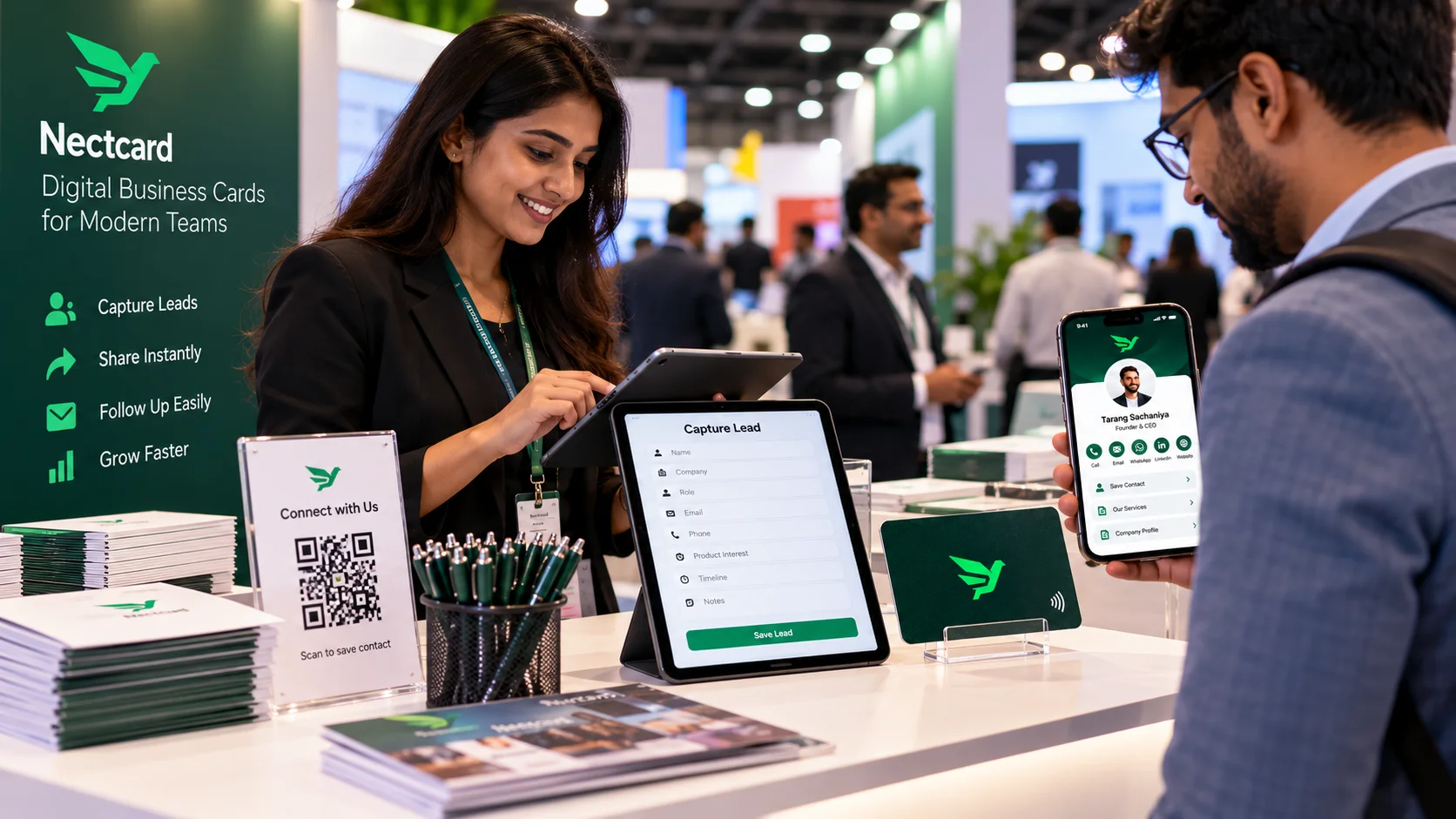
| Short form on a tablet or via a QR code | Structured details with nothing to retype | Keep it to three or four fields or people give up |
| Your NFC or QR digital card | The visitor saves your details in one tap or scan | It shares your details; you still have to capture theirs |
| Lucky draw or fishbowl | Pulling footfall to the stall | Fills your list with prize-hunters, so keep these entries separate |
Ask one simple filter question
If you run a lucky draw, Adams suggests adding a yes/no line to the entry form along the lines of "I'm only here for the giveaway, no follow-up needed", and leaving those people out of your sales list.
Tag hot, warm and nurture before you sleep
Each evening, go through the day's leads while you still remember the faces. A common split: hot means clear interest and buying signals such as asking about price; warm means a good fit with no buying signal yet; nurture means early or loose interest. It takes twenty minutes with a cup of chai and saves days later.
Where an NFC or QR card fits, and where it doesn't
A digital card helps the visitor save you. When they tap your card or scan its QR code, your profile opens in their phone's browser with a Save contact button, so you're in their contacts before they walk to the next stall. It's handy for team members walking the aisles away from the stall, where nobody is holding a form. If you're unsure whether to rely on tap or scan, read NFC vs QR business cards.
Be clear about what it doesn't do. A Nectcard shares your profile; it doesn't fill your lead sheet for you. You still need the visitor's name, need and next step written down. Every Nectcard also carries a QR code for phones that don't tap, and nobody needs an app to open the profile. For how the tap actually works, see how NFC business cards work.
After the show: the first 48 hours
Follow-up guides agree on two things: speed matters, and a message that mentions the actual conversation beats a generic "thanks for visiting our stall". Here's a simple plan:
- Evening of each show day: tag every lead and fill in missing notes.
- Within 24 hours: call your hot leads and offer the next step you discussed.
- Within 48 hours: send warm leads a personal message on email or WhatsApp that mentions what they asked about.
- Day three onwards: chase anyone who hasn't replied once more, on a different channel.
- Nurture leads: add them to occasional updates rather than pushing for a meeting.
And do whatever you promised at the stall. If you said you'd send a sample or a price list by Thursday, send it by Thursday.
How this works in different industries
- Sales teams: give every rep the same qualifying questions and tags so leads from different people can be compared, and decide who owns which lead before the show opens.
- Real estate: at property expos, note budget, preferred area and configuration, and whether they want a site visit. Your follow-up is usually a specific site visit slot, not a brochure.
- Restaurants and retail: at food, franchise or retail fairs, separate trade buyers and distributors from shoppers. A distributor asking about margins is hot; a shopper who liked the sample is nurture.
- Freelancers and consultants: you're often the stall and the sales team. Type a note on your phone right after each chat and offer one concrete next step, like a short call that week.
- Creators and coaches: at workshops and events, note which topic each person cared about so your follow-up can point them to the right session or batch.
Mistakes to avoid
- Mixing lucky-draw entries with real enquiries
- Waiting a week to sort the cards
- Sending one generic thank-you message to everyone
- Letting each staffer keep leads on their own phone
- Promising a quotation at the stall and forgetting to send it
The short version
Decide what you'll capture before the expo, write one honest line about every real conversation, tag leads each evening and reach the hot ones within a day. The visiting cards are just the starting point.
Kitting out your expo team?
Nectcard makes cards for whole teams, with the same design for everyone and a separate editable profile for each person.