For architects and interior designers, a digital visiting card is useful mainly because it can carry your work: a small gallery of finished projects and a walkthrough video that the client can open on their phone right there at the site. Keep the card factual, use only a title you're entitled to, and remember that only people registered with the Council of Architecture can call themselves an architect in India.
Why a paper card undersells design work
You're standing in a half-finished flat with a client who's trying to picture what their living room could look like. You hand over a card with your name and number. It says nothing about your taste, which is the one thing they're actually deciding on.
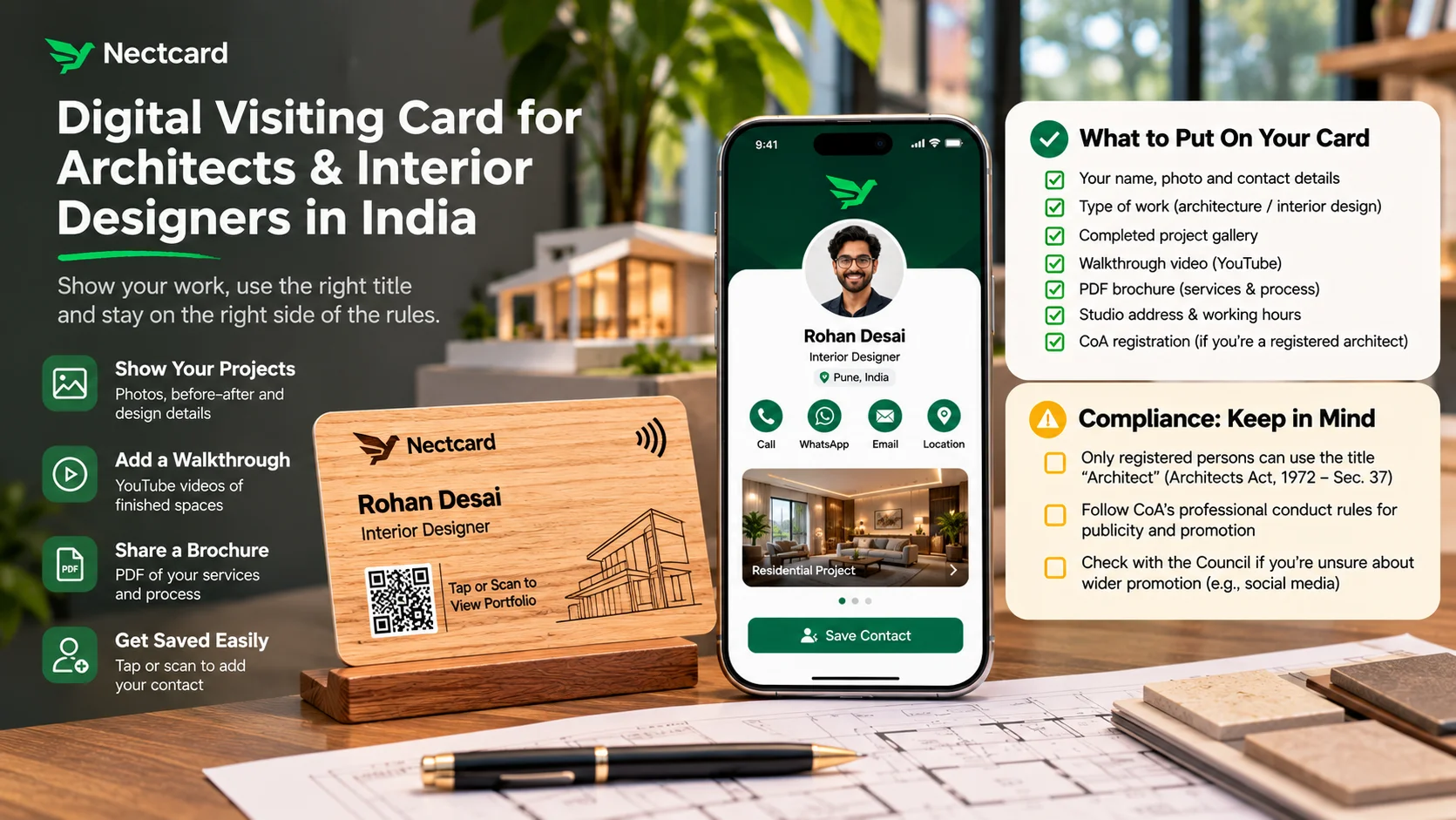
A digital profile can hold photos of completed projects, YouTube walkthroughs and a downloadable PDF brochure. The client taps your card or scans the QR code, the profile opens in their browser, and they can save your number in one tap. For the tap basics, read how NFC business cards work.
Who can use the word "architect"
This matters more than any design choice on the card. In Council of Architecture v. Mukesh Goyal, decided on 17 March 2020, the Supreme Court held that the Architects Act, 1972 doesn't stop unregistered people from doing architectural work, but Section 37 does bar them from using the title "architect".
The Council of Architecture repeated this in a public advisory reported on 2 August 2026. It said only people registered with the Council may use the title anywhere in India, that misuse can be prosecuted under Sections 36 and 37 of the Act along with the Bharatiya Nyaya Sanhita, and it advised developers and the public to check an architect's registration on the Council's website before hiring.
So if you're an interior designer who isn't registered with the CoA, call yourself an interior designer, a space planner or whatever describes your work, and keep the word "architect" off your card and profile. If you are registered, adding your CoA registration helps clients who want to verify you, which the Council is now actively telling them to do.
What the CoA conduct rules say about publicity
Registered architects have another layer to think about. The Architects (Professional Conduct) Regulations, 1989 say an architect shall not advertise professional services, with a list of exceptions. Those exceptions include a name board of limited size, the architect's name appearing alongside press coverage of their work as long as no payment changes hands, brochures about the architect's experience and capabilities sent to specific, named potential clients, and listings in directories or on websites.
The regulations don't mention visiting cards or digital profiles at all. A card you hand to one person you've just met looks closer to a capability brochure for a named client than to a public ad, but that's our reading, not a ruling. If you're registered and plan to share your profile widely, say on social media, check with the Council first. Interior designers who aren't registered architects aren't covered by these conduct regulations, though the title rule above still applies.
What to show on your profile
| Section | Architects (registered) | Interior designers |
|---|---|---|
| Title | Architect, with CoA registration | Interior designer or similar. Not "architect" |
| Project gallery | Completed work, described factually | Completed work, before-and-after if you have the client's OK |
| Walkthrough video | A YouTube link to a project flythrough | A short room-by-room walkthrough |
| PDF brochure | Experience and capabilities | Services, process and the kind of projects you take |
| Services list | Plain description of the scope you handle | Turnkey, design only, modular kitchens, and so on |
| Things to skip | Claims like "best architect in the city", paid awards | Using photos of projects that aren't yours |
Setting it up, step by step
- Decide your title first, using the rule above. Everything else follows from it.
- Pick your strongest finished projects and get each client's permission before posting photos of their home or office.
- Write a one-line caption for each project: type of space, city, and what you did. Keep it factual.
- Upload a walkthrough to YouTube and add the link to your gallery. Big design files like CAD or 3D models are better shared separately after the meeting.
- Add a PDF brochure with your services and process, so the client can forward it to family or a business partner.
- Add WhatsApp, your studio location on Maps, and your working hours.
- Test the card on an iPhone and an Android phone at an actual site, where the network might be weak, and check the QR code too.
- Refresh the gallery when you finish a new project. The physical card stays the same.
Who this helps most
- Solo studios and one-person practices: your card is often the first thing a referred client sees, so lead with two or three finished projects in the style you want more of. More for freelancers and consultants.
- Designers working with builders on new projects: show sample flats you've done so buyers who meet you at the site know what you can do with the same floor plan. See real estate.
- Shop, cafe and restaurant interiors: commercial clients want to see spaces that work for customers, so add photos of finished shopfronts and seating layouts with the owner's permission. See restaurants and retail.
- Designers who build their name on Instagram: link your page, but keep the card's gallery to finished work rather than mood boards. See creators and coaches.
- Firms with several designers: give everyone the same layout with their own details and portfolio. See team cards.
Mistakes to avoid
- Using the title "architect" without CoA registration, even in a small tagline.
- Posting photos of a client's home without asking them first.
- Filling the gallery with renders when you have finished work to show. Label renders clearly if you use them.
- Adding superlatives like "top" or "No. 1" that you can't back up.
A short wrap-up
Clients pick a designer on the strength of their work, so put that work where the client can see it in the first meeting. Get the title right, keep the profile factual, and refresh it when you finish something you're proud of. If you like the look, a wooden NFC card tends to suit design studios.
See how the cards look
Plastic, wooden or metal cards with a profile you can edit any time.