An NFC business card is worth it if you meet new people face to face often, your details change now and then, and you want them saved on the other person's phone instead of lost in a drawer. It's probably not worth it if you rarely network in person, need cards for an event tomorrow, or mostly meet people online. The rest of this guide helps you work out which side you're on.
What you're actually paying for
You come back from an expo with a pocket full of paper cards and half of them never get typed into your phone. An NFC card tries to fix that. The person taps it on their phone, your profile opens in the browser, and they can save your number in one go. No app is needed on either side, as long as NFC is switched on.
The bigger value is that the card is a pointer, not a printout. Your phone number, WhatsApp, website or office address live on an online profile you can edit. Paper cards need a fresh print run every time one of those changes. NFC card makers make the same point: the higher upfront cost is meant to be offset by not reprinting.
That's the trade-off in one line. You pay more at the start than you would for a box of paper cards, and you save on reprints and retyping later. Whether that adds up depends on how you work. If you want the rupee maths over a few years, our digital vs paper visiting card cost guide walks through it.
When an NFC card pays off
- You meet new people in person every week: site visits, client meetings, expos, society events.
- Your details change sometimes: a new number, a new branch, a new website or a new role.
- You want people to land on more than a phone number, like your WhatsApp, services, Google location or a brochure.
- You're tired of reordering paper cards and throwing away old stock.
- Some of your contacts would rather tap or scan than type your number in by hand.
When it probably isn't worth it
Even companies that sell NFC cards admit they don't suit everyone. Blinq and HiHello both list cases where a physical NFC card makes less sense. Here's the honest version:
- You mostly network online. A tap only works in person, so a link or QR in your email signature does more for you.
- You need cards in a hurry. An NFC card has to be made and shipped, so it won't help for an event tomorrow morning.
- Your audience uses older or basic phones. Some budget Android phones don't have NFC, and some ship with it turned off. iPhone XS and newer read tags in the background, while older iPhones need extra steps.
- Your printed name or title changes often. The profile updates online, but anything printed on the card itself doesn't.
- You won't keep the profile up to date. The card only opens a page. If that page is stale, the tap falls flat.
A quick five-question check
Answer these honestly. If you say yes to three or more, an NFC card is likely to earn its keep.
- Did you meet five or more new people in person in the last month?
- Have you reprinted your visiting cards, or crossed something out by hand, in the last two years?
- Do you want people to reach you on WhatsApp, see your work or find your location, not just call?
- Will you actually update your profile when something changes?
- Do most of the people you meet carry smartphones?
NFC card, paper card or a free digital card?
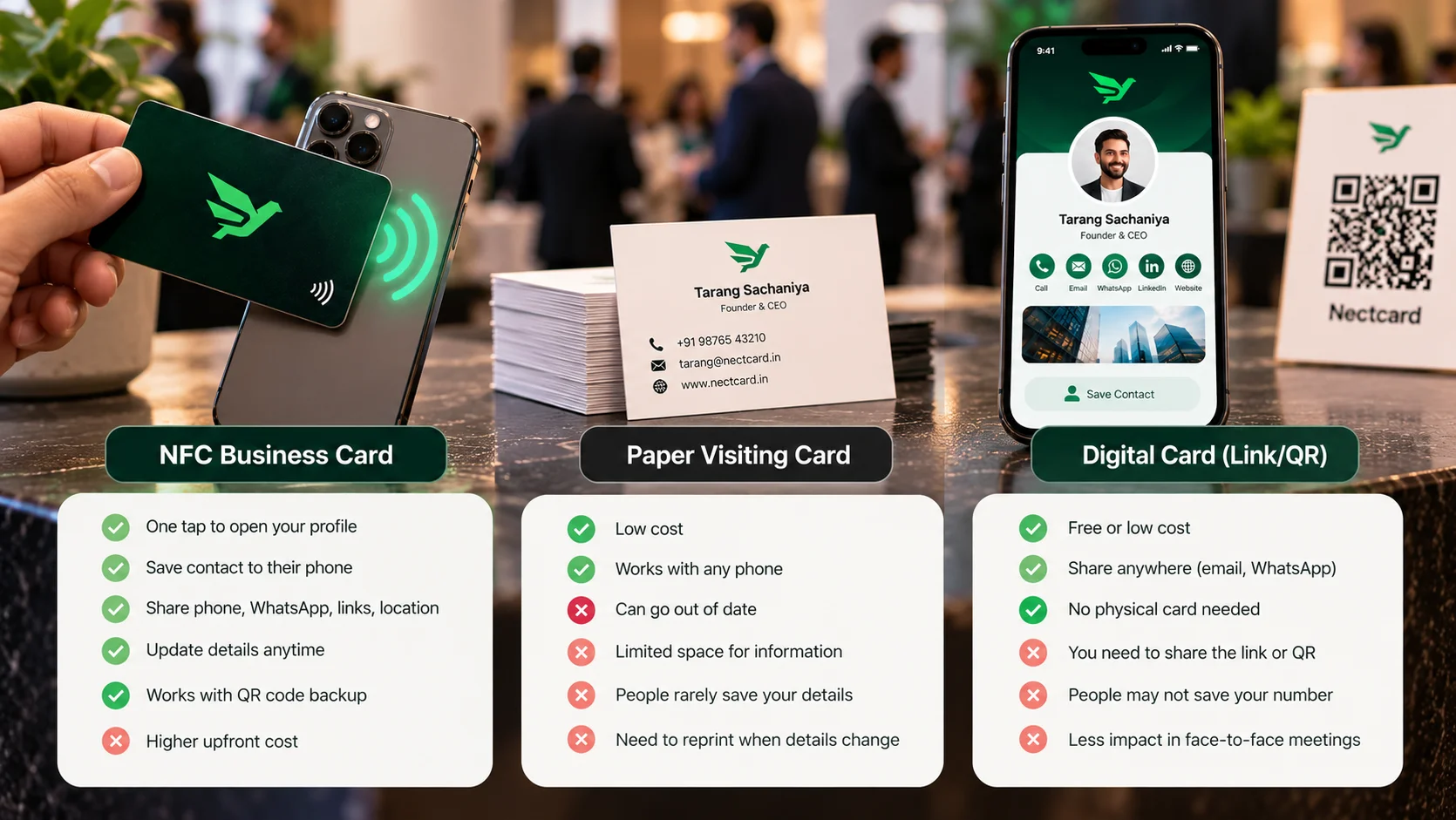
These aren't the only three options, but they're the ones most people weigh up. Some apps give you a digital card for free with no physical card at all, which is worth knowing if your budget is tight.
| Paper visiting card | Free digital card (app or link) | NFC card with QR | |
|---|---|---|---|
| Upfront cost | Low per box | Nothing for basic plans | Higher, one card per person |
| When details change | Reprint the whole box | Edit online | Edit online, no reprint |
| How it's shared | Hand over | Send a link or show a QR on your screen | Tap or scan the card |
| Works without a smartphone | Yes | No | The printed details on the card still help |
| Good for remote contacts | No | Yes | Share the same profile link |
| Ready for an event tomorrow | Usually, if a local printer is quick | Yes | No, it needs to be made and shipped |
Already sure you want a tap-and-scan card? Our NFC vs QR guide explains why the card has both.
Who this helps most
- Sales teams: reps meet many prospects in person, and roles or territories change. Editing a profile beats reprinting cards for the whole team every time.
- Real estate agents: at a site visit the buyer can tap, save your number and open your listings on WhatsApp before they leave the flat.
- Doctors and clinics: put clinic timings, location and an appointment number on the profile, and update timings when they change without printing new cards.
- Restaurants and retail: a card at the billing counter can open your menu, location and UPI details, which paper can't keep current.
- Freelancers and consultants: if most of your work comes through online referrals, a free digital link may be enough. If you pitch in person, the tap helps you look prepared.
Mistakes that make an NFC card feel like a waste
- Buying a card without a QR backup, then finding some phones won't tap.
- Filling the profile once and never touching it again.
- Putting only a phone number on the profile. Add WhatsApp, location and what you do.
- Paying for a premium material when a plastic card would do the job. Tap and scan work the same on every material.
- Not checking what happens when the plan ends, so its expiry catches you out.
Where Nectcard fits
If you've decided it's worth it, Nectcard works on a pay-once plan of one, two or three years with no monthly fee. The plan covers the card and your hosted profile. Every card has a QR backup, the profile opens in the visitor's browser without an app, edits are unlimited, and cards ship free across India. Prices change, so see the current price list rather than relying on an old screenshot.
The short answer
An NFC card is worth it when you meet people in person often and your details don't stay still. If that isn't you, a free digital link or a small box of paper cards is a sensible choice, and there's nothing wrong with that.
Ready to try a tap-and-scan card?
Plastic, wooden or metal, each with a QR backup. Ships free across India.